Aspects
So far we’ve treated each placement on its own, a planet, a sign, a house. But a chart isn’t a list. As the planets orbit, they form angles to one another, and certain angles carry meaning. Astrologers call these aspects. An aspect describes the relationship between two planets’ energies: whether they cooperate, argue, blend, or pull in opposite directions.
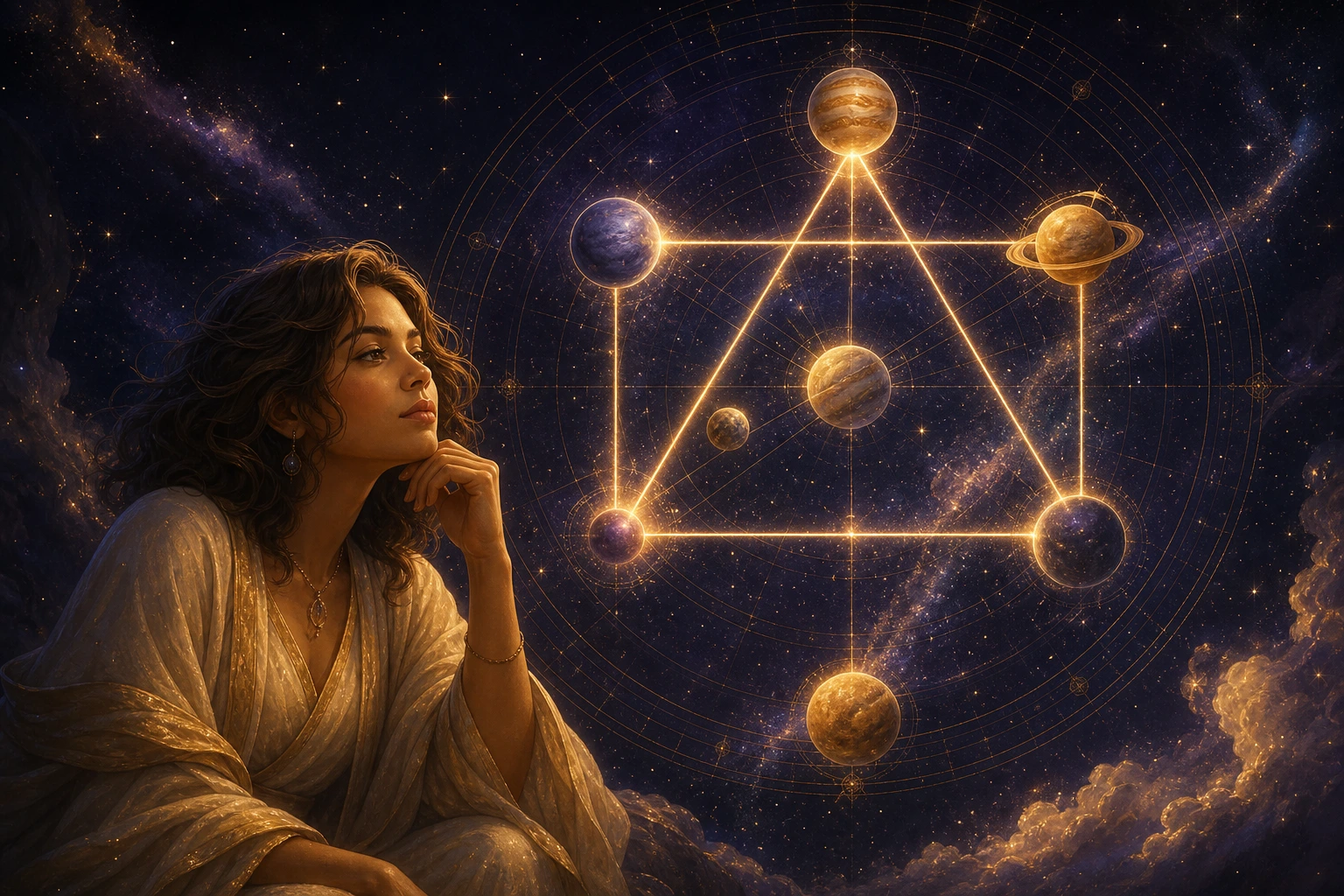
The angle is the conversation
Picture the chart as a circle of 360 degrees with the planets placed around its rim. Measure the angle between any two of them. If that angle lands near one of a handful of special values, the two planets are “in aspect”, they’re in conversation. The size of the angle tells you the tone of that conversation.
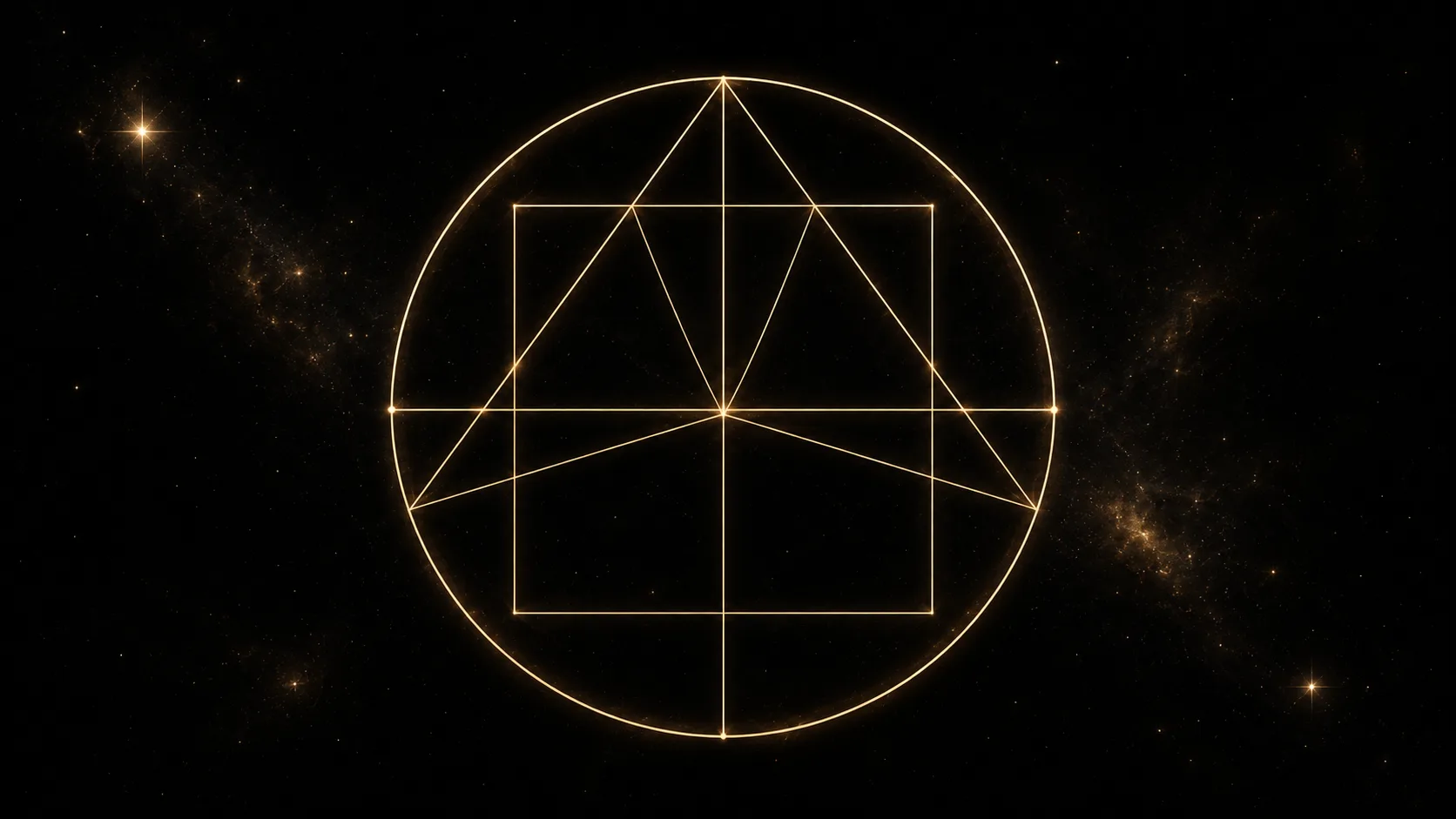
The five major aspects
These five do most of the work in any chart. Learn them and you can read most of what a wheel is saying.
The two planets sit together in the same spot. Their energies blend and amplify each other, for better or worse depending on which planets they are. The most powerful aspect, because the two are fused into a single force.
The planets face off across the chart, mirror opposites. A push-pull you tend to become aware of through other people, who reflect the missing half back at you. The work is balance.
Easy, flowing, effortless. The two planets support each other without friction, this is talent that comes naturally, so naturally you may not even notice you have it.
The planets grate against each other, tension that demands action. Squares are uncomfortable, but they’re the engine of growth: the friction that forces you to develop.
Supportive and open, but it won’t happen on its own. A sextile is a door standing ajar, the potential is there, yet you have to choose to walk through it.
There are also minor aspects (the semisextile (30°), the semisquare (45°), and the quincunx (150°)) which work in subtler shades and carry less weight. When you’re starting out, you can read a chart well using only the five majors above.
The orb: a little room to be inexact
Two planets are almost never at the exact angle. A trine at 119° or 121° is still, in every way that matters, a trine. So astrologers allow a buffer (called an orb) of a few degrees on either side, within which the aspect still counts. The tighter the orb, the stronger and more defining the aspect; an aspect that’s nearly exact dominates the chart.
Think of the orb as the aspect’s volume. A 0° orb is the conversation shouted; a 6° orb is the same conversation murmured in the next room.
We’ll look more closely at how wide an orb each aspect deserves in the next chapter. For now, just know that “close enough” is a real and accepted idea.
Mira’s chart, wired together
This is where Mira’s chart stops being a list and starts being a person. Here are four real aspects from her wheel, every angle and orb below is genuine, calculated by Luune’s engine from her birth data.
First, the tightest and most telling one. Mira has Venus conjunct Mars in Cancer, an orb of about 1°, almost exact:
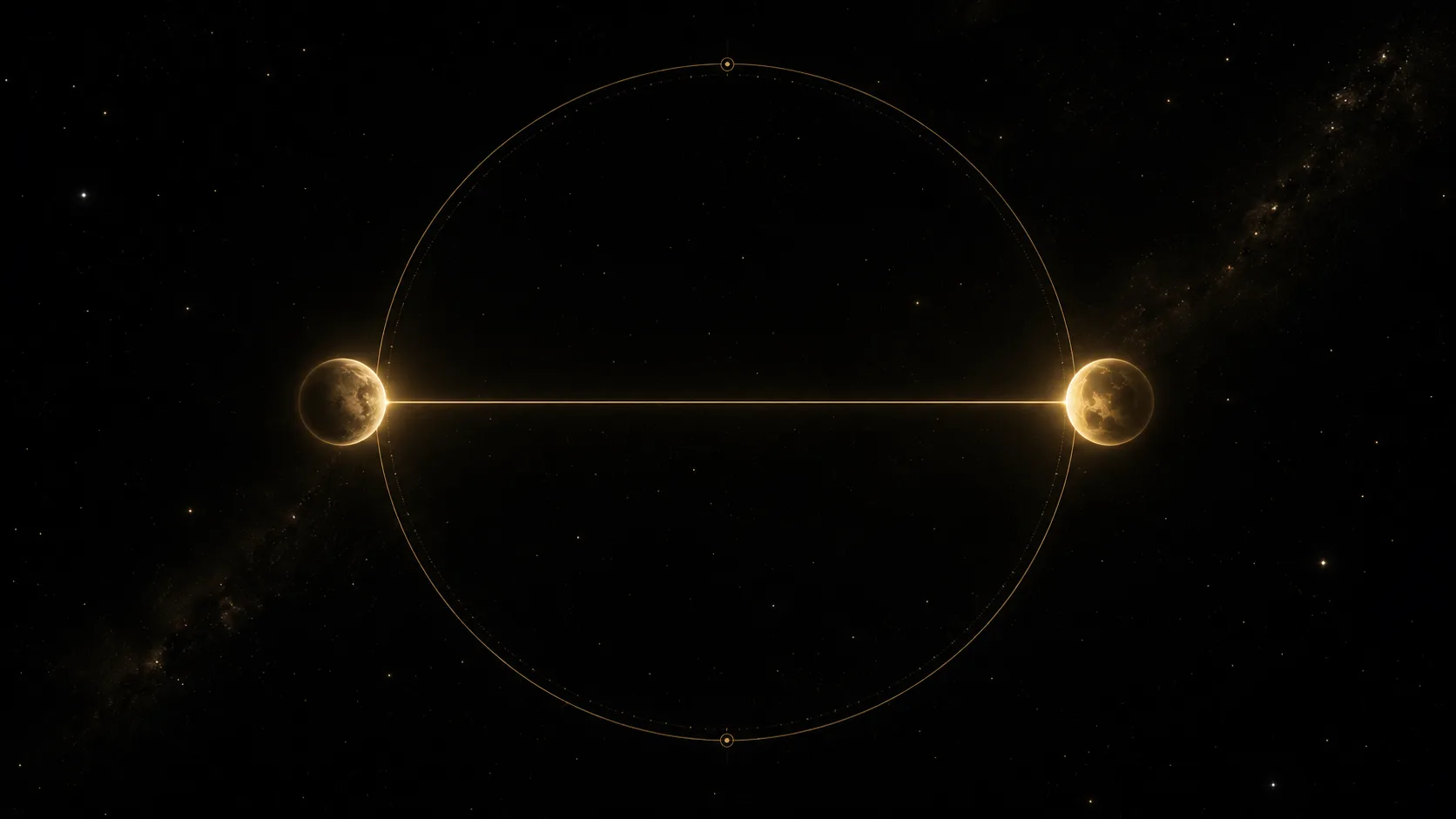
Next, the most dramatic. Her Sun is opposite Uranus, and at roughly a 0.5° orb, this is the tightest aspect in her chart, which makes it a defining theme of her life:
Not every aspect is tension, though. Mira also has a Sun trine Moon at about a 4° orb. Her Sun is in Leo and her Moon in Sagittarius (two fire signs, 120° apart) so who she is and what she feels flow together easily, with none of the inner conflict the opposition brings. The two halves of her cooperate by default.
And running underneath it all: Moon conjunct Pluto in Sagittarius, an orb of about 1°. Her emotional life (Moon) is fused with the planet of depth and intensity (Pluto), nothing she feels is ever shallow or casual; it all runs deep.
From a list to a living system
This is the leap. On their own, the placements are a roster of facts, Sun here, Moon there. Aspects are the wiring between them: the lines of tension, ease, and fusion that make those facts interact. A chart with its aspects drawn in stops being an inventory and becomes a living system, a set of energies in constant conversation, arguing and agreeing inside one person.
Placements tell you what’s in the room. Aspects tell you how everyone in the room gets along.
Frequently asked questions about aspects
What is an aspect in astrology?
An aspect is a meaningful angle between two planets on the chart wheel. Astrology treats the chart as a circle of 360 degrees with the planets around its rim; when the angle between two of them lands near certain special values, they're "in aspect" — in conversation. The size of the angle tells you the tone: cooperation, tension, blending, or push-pull.
What are the five major aspects?
The conjunction (0°) fuses two planets into one amplified force; the opposition (180°) is a push-pull you feel through other people; the trine (120°) is easy, flowing, effortless harmony; the square (90°) is friction that demands action and drives growth; and the sextile (60°) is a door standing ajar — an opportunity you have to choose to walk through.
What is the difference between a square and a trine?
A trine (120°) is harmony — the two planets support each other without friction, often a talent so natural you don't notice you have it. A square (90°) is friction — the planets grate against each other in tension that demands action. Squares are uncomfortable, but they're the engine of growth that forces you to develop.
What is an orb in astrology?
An orb is the buffer of a few degrees on either side of an exact aspect within which it still counts — a trine at 119° or 121° is, in every way that matters, still a trine. The tighter the orb, the stronger and more defining the aspect: think of the orb as the aspect's volume, with a 0° orb being the conversation shouted and a 6° orb the same conversation murmured in the next room.