House systems
Once you know the houses are the “where” of a chart, a strange question appears: where exactly does one house end and the next begin? It turns out astrologers have never fully agreed. There are many ways to slice the sky into twelve houses, and they don’t all draw the lines in the same place.

Why there’s more than one answer
Here is the good news first: every house system agrees on the planets and the signs. Your Moon is in the same sign and at the same degree no matter which one you use. What they disagree on is where the house boundaries (the cusps) fall.
The reason is physical. Houses aren’t fixed in space the way signs are; they depend on your horizon and on the spin of the Earth at the exact moment and place you were born. To turn that tilted, rotating, three-dimensional sky into a flat wheel on a page, you have to project it, and there is more than one defensible way to do the projection. Each method makes a different reasonable choice about what to keep faithful and what to let stretch.
Different house systems are different maps of the same territory. The land doesn’t move, only the grid lines drawn over it do.
The three best-known systems
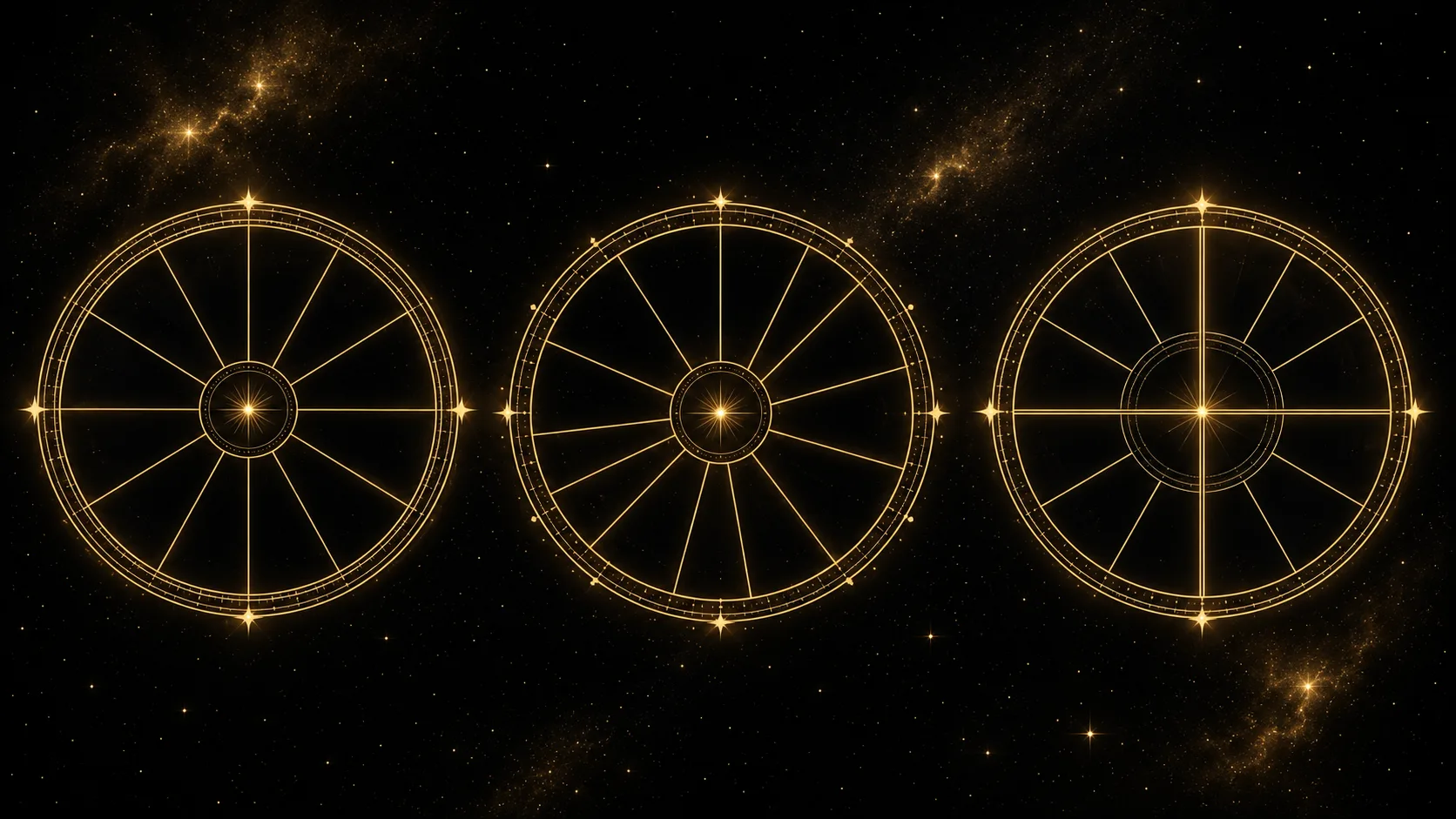
Dozens of systems exist, but three account for nearly everything you’ll meet in practice. Here they are, side by side and fairly.
Whole Sign
The most ancient system. Whatever sign is rising on your Ascendant becomes your entire 1st house; the next sign is the whole 2nd house, and so on around the wheel. Every house is exactly 30°, perfectly even. Simple, ancient, and increasingly popular again today.
Placidus
The most widely used system today. It’s time-based: it divides the path each degree of the sky takes between the horizon and the meridian overhead. So houses are usually unequal in size, and the distortion grows the farther you are from the equator. It even breaks down past about 66°N/S, where some degrees never touch the horizon at all.
Porphyry
Prioritizes the four angles (the Ascendant, Descendant, Midheaven, and IC) fixing them as the 1st, 7th, 10th, and 4th cusps. Then it simply trisects the space between each pair of angles into three even houses. A clean, geometric middle ground.
What Luune uses
To keep things honest and consistent: Luune uses Placidus. Our chart engine computes every house with the Placidus system, which means every house placement you see anywhere on Luune (and everywhere in this guide, including Mira’s) is a Placidus house. When you read that Mira’s Mars sits in her 5th house, that’s Placidus telling you so.
Whenever a number on Luune says “house,” it means the Placidus house. No guessing required.
You don’t need to worry about this
If all of that felt like a lot, here’s the reassuring part. The planets and signs never change between systems, only the cusps shift, and usually that only matters for a planet sitting near a boundary. A planet parked comfortably in the middle of a house stays in that house no matter which method you pick. For most charts, the differences between systems are modest.
So when you’re starting out, you don’t have to choose. The default to trust on Luune is Placidus, it’s what nearly every modern astrologer reads from, and it’s what every chart in this guide is built on. If you ever get curious about the alternatives, you’ll now know exactly what they’re doing differently.
Frequently asked questions about house systems
What is the difference between Placidus and Whole Sign houses?
Whole Sign is the oldest system: whatever sign rises on your Ascendant becomes your entire 1st house, the next sign the whole 2nd, and so on — every house is exactly 30°. Placidus is time-based: it divides the path each degree of sky takes between the horizon and the meridian, so its houses are usually unequal and the distortion grows the farther you are from the equator.
What is the Porphyry house system?
Porphyry is a geometric middle ground. It fixes the four angles — the Ascendant, Descendant, Midheaven, and IC — as the 1st, 7th, 10th, and 4th cusps, then simply trisects the space between each pair of angles into three even houses. It's a clean compromise between Whole Sign's evenness and Placidus's time-based slicing.
Which house system does Luune use?
Luune uses Placidus. Our chart engine computes every house with the Placidus system, so every house placement you see anywhere on Luune — and everywhere in this guide, including Mira's — is a Placidus house. Placidus is what nearly every modern astrologer reads from.
Do house systems change my planets and signs?
No. Every house system agrees on the planets and the signs — your Moon is in the same sign and at the same degree no matter which one you use. They only disagree on where the house boundaries (the cusps) fall, and usually that only matters for a planet sitting near a boundary. A planet parked in the middle of a house stays there whatever method you pick.