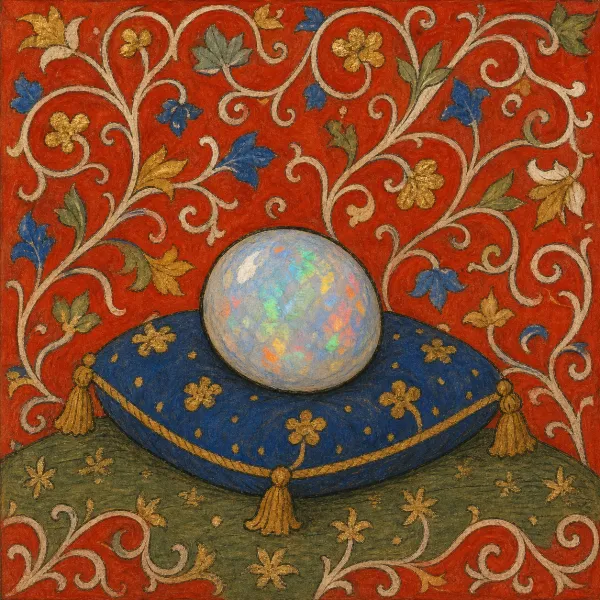
Opal
Opal — a shifting fire of every colour at once; a stone of imagination, creativity, and changeable magic.
The October birthstone: Opal
October's birthstone is the opal, the most unusual gem of the calendar. Where other stones have a single colour, an opal has all of them — and none. Tilt one in the light and it throws back flashes of green, blue, orange, violet, and red that drift and shift as you move it, a phenomenon jewellers call play-of-colour. No two opals are alike, which is exactly the point: it's the gem of the individual and the imagination.
The Romans thought opal the most precious and powerful of stones precisely because it seemed to contain the colours of all the others — they called it opalus, 'precious stone', and believed it carried the virtues of every gem at once. It became associated with creativity, hope, and inspiration, and with the shifting, dreamlike quality of the imagination. (Its reputation for bad luck is a much later invention, born partly from a 19th-century novel and from jewellers frustrated by the stone's softness — there's no old tradition behind it.)
Opal's magic is structural: it's made of countless tiny silica spheres stacked in a grid, and when they're regular enough they diffract light into spectral colour, like the surface of a soap bubble. It also holds water — up to a fifth of its weight — which is why it can be delicate. Australia produces the vast majority of the world's fine opal, including the dark, fiery black opal of Lightning Ridge; Ethiopia and Mexico (home of fire opal) are other notable sources.
October birthstones: modern, traditional & mystical
Different traditions assign October different stones. The modern list (set by the American jewellery trade in 1912 and the one most charts use today) sits alongside the older traditional list and the centuries-old Tibetan “mystical” list.
Meaning & symbolism
Because it seemed to hold the colours of every other gem at once, the Romans thought opal the most powerful stone of all and named it opalus, the precious stone — believed to carry every gem's virtue together. From that came its link to creativity, hope, and the shifting, dreamlike quality of the imagination, the gem of the individual who refuses to be just one thing. Its reputation for bad luck is a much later invention, born of a 19th-century novel — there's no old tradition behind it.
Properties & benefits believed
Opal is a stone of imagination, creativity, and emotional expression. It's said to amplify feeling and inspiration, to spark originality, and to bring out what's hidden or unspoken in its wearer. A gem of hope and transformation, it carries associations with spontaneity, intuition, and the shifting, many-coloured nature of an inner life.
These are traditional and folkloric associations, the meanings cultures have attached to opal over centuries, not medical claims. Worn as a birthstone, it’s above all a way of carrying your month with you.
Color & origin
Opal is prized for its iridescent play-of-colour colour. Australia produces most of the world's fine opal, including the prized black opal of Lightning Ridge; Ethiopia and Mexico are other notable sources.
Who Opal suits
Opal suits the creative and the many-sided — imaginative people who refuse to be just one thing. Born in shifting, colourful October, they tend toward originality, charm, and a changeable depth. If you contain multitudes and never show the same face twice, this is your stone.
The zodiac signs of October
October spans two zodiac signs, depending on where in the month you were born. Read your sign to see how its story lines up with your stone.
Frequently asked questions about Opal
- What is the birthstone for October?
- The birthstone for October is Opal — a iridescent play-of-colour gem associated with water & imagination. Opal — a shifting fire of every colour at once; a stone of imagination, creativity, and changeable magic.
- What does Opal symbolise?
- Because it seemed to hold the colours of every other gem at once, the Romans thought opal the most powerful stone of all and named it opalus, the precious stone — believed to carry every gem's virtue together. From that came its link to creativity, hope, and the shifting, dreamlike quality of the imagination, the gem of the individual who refuses to be just one thing. Its reputation for bad luck is a much later invention, born of a 19th-century novel — there's no old tradition behind it.
- What are the believed properties of Opal?
- Opal is a stone of imagination, creativity, and emotional expression. It's said to amplify feeling and inspiration, to spark originality, and to bring out what's hidden or unspoken in its wearer. A gem of hope and transformation, it carries associations with spontaneity, intuition, and the shifting, many-coloured nature of an inner life.
- Which zodiac signs share October?
- October spans two zodiac signs: Libra and Scorpio. Which one applies depends on your exact birth date within the month.
- Who does Opal suit?
- Opal suits the creative and the many-sided — imaginative people who refuse to be just one thing. Born in shifting, colourful October, they tend toward originality, charm, and a changeable depth. If you contain multitudes and never show the same face twice, this is your stone.